
The Person Regional Teams Call When the Local Read Doesn't Match the Global Plan.
With a background in market insight, stakeholder strategy, and strategic communications, I help multinational organizations translate regional priorities into market-relevant strategy across Southeast Asia, with particular depth in Indonesia.

“A Regional Playbook Can Tell a Team What to Prioritize. It Rarely Tells Them Whether That Priority Lands the Same Way in Jakarta as It Does in Singapore.”
Years spent inside market localization, stakeholder strategy, and executive positioning work, across sectors from financial services to enterprise technology, have given me a practical, firsthand read on how business priorities, stakeholder expectations, executive narratives, and local market realities interact.
Working across large, multi-market organizations has also exposed me to how much gets lost when a regional plan meets a market it was never built for.
That perspective shapes how I approach market localization: not as a translation exercise, but as a strategic process for deciding what needs to adapt, what can remain consistent, and where local context should influence the direction. What usually gets missed isn't the facts. It's what genuinely makes people here trust a brand or respond to a message, and that's rarely the same thing that worked somewhere else.
What Shaped How I Work, beyond the Job Titles.
REMOTE FROM THE START
Collaborating asynchronously with teams across the US, UK, EU, and APAC has been part of the job since the earliest roles. Reading cultural context and communication habits with no shared office or shared time zone to lean on is the same skill any accurate market read depends on: catching what's unspoken, not just what's stated.
ASSUMPTIONS THAT DON'T TRAVEL
Working across Indonesia, Singapore, Malaysia, Thailand, Vietnam, the Philippines, and, in past work, Australia, the same assumptions get tested again and again. A level of formality that reads as respectful in one market can read as distant in another. Who counts as an authority differs by market and by industry. And a global plan's timeline rarely matches how long trust takes to build on the ground.
JUDGMENT BACKED BY EVIDENCE, NOT JUST INSTINCT
Ongoing training in business intelligence and analytics runs alongside the client work, pairing the qualitative read from direct experience with measurable evidence. What that means in practice: a recommendation that traces back to something concrete, not a gut call presented as one.
Not all of that perspective comes from training or client work. Every week I make time for professional communities and events, through webinars, community programs, and in person. Hearing how people approach their challenges widens the perspective I bring into client work.
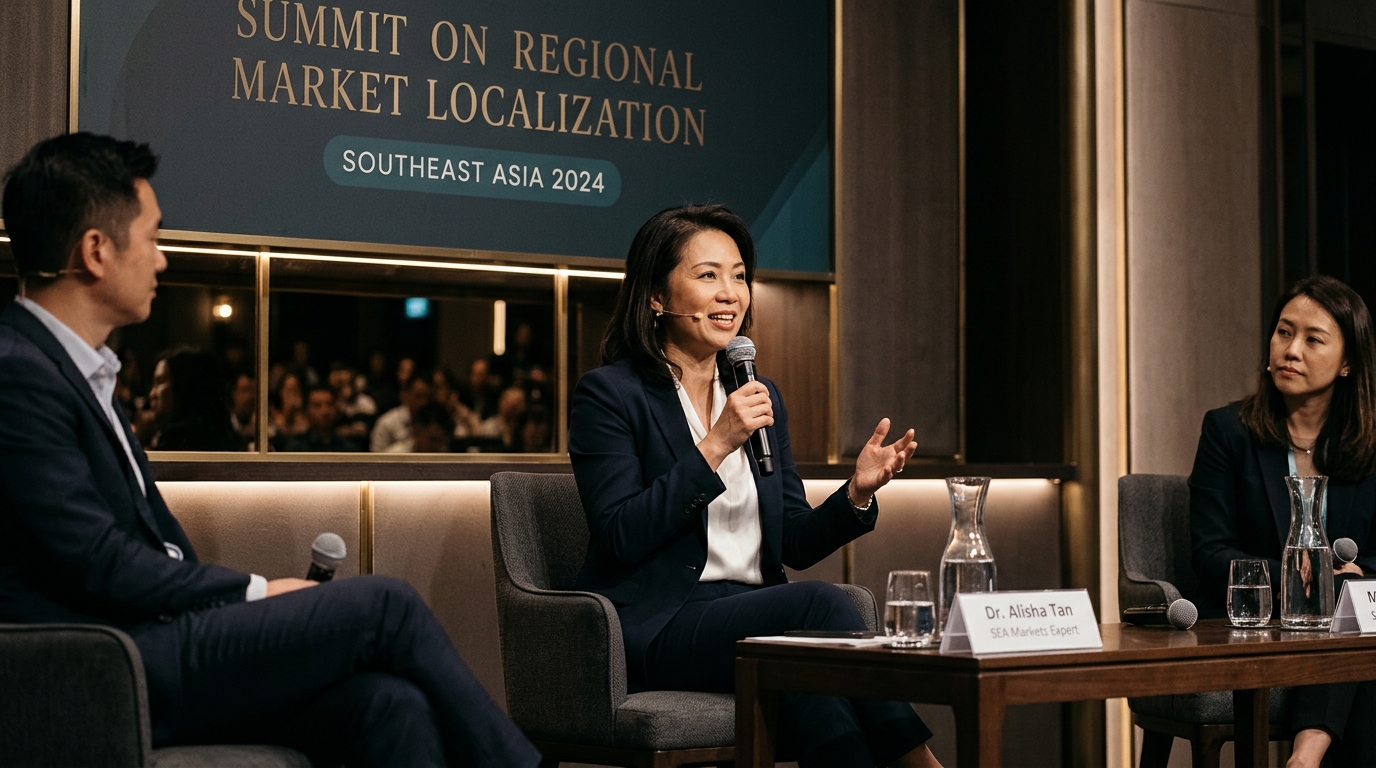
Regional localization and market entry panel

Executive closed-door roundtable moderation

Cross-border trade council peer exchange
1+ year as an independent localization strategist, built on 4+ years in agency and startup communications roles
Market research, localization strategy, stakeholder analysis, communications strategy, and executive advisory
Across technology, financial services, logistics, professional services, and consumer sectors
Partnering with regional teams and stakeholders on cross-border initiatives across APAC, the EU, the UK, and the US
What That Range Actually Built.
That range wasn't just geographic. Markets that don't share a regulatory environment, a media landscape, or a cultural read teach a specific kind of judgment: what looks like the same problem in two markets rarely has the same answer, and the only way to know which is which is having sat in the room for both. Across sectors from technology to consumer goods, that meant advising the people who needed a read they could act on, not a report to file.
That same range shows up in budget too: enterprise brands with the resources to run a multi-market campaign without blinking, scaleups balancing growth against runway, and bootstrapped startups where every dollar has to earn its place before it gets spent. What's proportionate for an enterprise campaign isn't proportionate for a founder watching cash flow weekly.
That range didn't start with a strategy title. My career began in communications roles across a social-impact startup and a regional PR and digital marketing agency, progressing from Management Trainee to Senior Client Executive over three years, before I went independent in July 2025. That shift changed what the work was valued for: from producing output to providing judgment.
That's the Perspective. Let's Apply It to Your Market.
If this perspective matches how you're already thinking about your next market decision, let's talk it through.